










Digital scents could add a new dimension to virtual worlds
It's now possible to convert a handful of smells into electronic signals that can be sent through the internet

Imagine if, in addition to sharing photos of those muffins you just baked, you could share their delicious aroma, too. That’s the promise of an AI-assisted device that can transmit smells over the internet. So far, it works on only a small number of scents, including orange, beer and cake, but its creators hope the system will ultimately recreate more smells. The scent of a pine forest or the aroma of coffee, for example, could then add a new dimension to virtual worlds and long-distance communication.
Although it is now routine to communicate sight, sound and even touch sensations electronically, smell is “still a very undeveloped sense”, says Chunyu Yang at the Ohio State University. That’s partly because odours involve complex chemistry. Whereas vision, for example, can be broken down into combinations of red, green and blue pixels, says Yang, there’s no simple building block underlying smell. Any attempt to convert aromas into electronic signals has to recognise combinations of very different molecules.
To solve the problem, Yang and her colleagues built an electronic nose, or “e-nose”, as well as a smell generator, then used machine learning to connect the two. The e-nose consists of arrays of sensors made of metal oxide. When different gaseous components of smells, such as ethanol (from alcoholic drinks) or limonene (found in citrus fruits), bind to the sensors’ surface, this changes their resistance, creating different electrical signals.
Advertisement
The researchers then trained an AI algorithm to recognise the distinctive signals created by smells from five different foods or beverages: orange, cake, coffee, beer and red wine. Teaching the AI to correctly recognise the smells was “the most challenging part” of the entire study, says Yang, because to generate enough data to train the system, she had to expose the sensors to the various smells hundreds of times.
This information was then sent over the internet to a smell generation device that the researchers are calling “Scentronic”. This part of the system involves miniature containers holding liquids laced with each of the five smells. Above each container is an atomiser that vibrates in response to electric signals, forcing the liquid in the container through a cotton filter and releasing fine droplets into the air, creating the appropriate smell, or combination of smells.

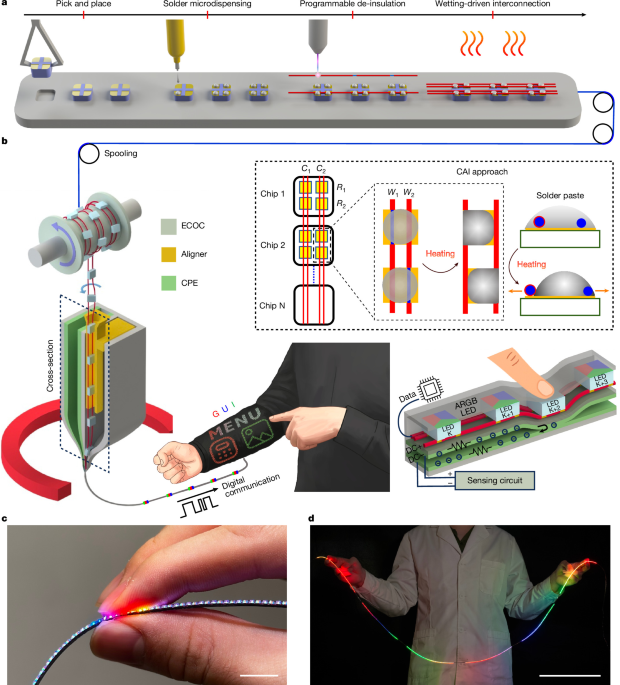
Yang built several different designs including stringing the atomisers onto a necklace and a wristband, and mounting them on a handheld device. When she tested the handheld device on 14 volunteers, they correctly identified the smells being transmitted to them 73 per cent of the time, on average.
She also built a prototype that reproduces taste, involving a cup of water with electromagnetic pumps containing flavoured liquid fixed around its edge. “When it receives information from the internet, the corresponding liquid will be dropped into the cup.”
Alternative methods to generate smells remotely have been suggested, including heating wax to release particular scents, and even stimulating neurons directly to create the experience of smell. But Yang argues her method is both fast and practical. She now hopes to expand the repertoire of the system, to create more complex aromas.

She suggests the entertainment industry could be first to develop the technology, to create more immersive virtual worlds. But there could also be health applications. For instance, the smell of food transforms the eating experience, so the technology could be adapted to make soldiers’ or astronauts’ rations more palatable. The Scentronic system could also enable doctors to assess distortions in patients’ sense of smell, for example, in post-viral illness or neurodegenerative disease.
The Scentronic system is “a great idea” and a step in the right direction, says Marianna Obrist at University College London, although she points out that recognising a smell and then releasing a matching one from a limited library is very different from the ease with which we can transmit sound and vision. “There’s still a long way to go before we can truly record and replay smell experiences.”
Science Advances DOI: 10.1126/sciadv.aee9266
What's Your Reaction?