








NASA’s Hubble Charts Path for Roman with Gravitational Lenses
This observation is one of many gravitational lensing images taken by Hubble in preparation for science with the new Nancy Grace Roman Space Telescope.
4 min read
NASA’s Hubble Charts Path for Roman with Gravitational Lenses
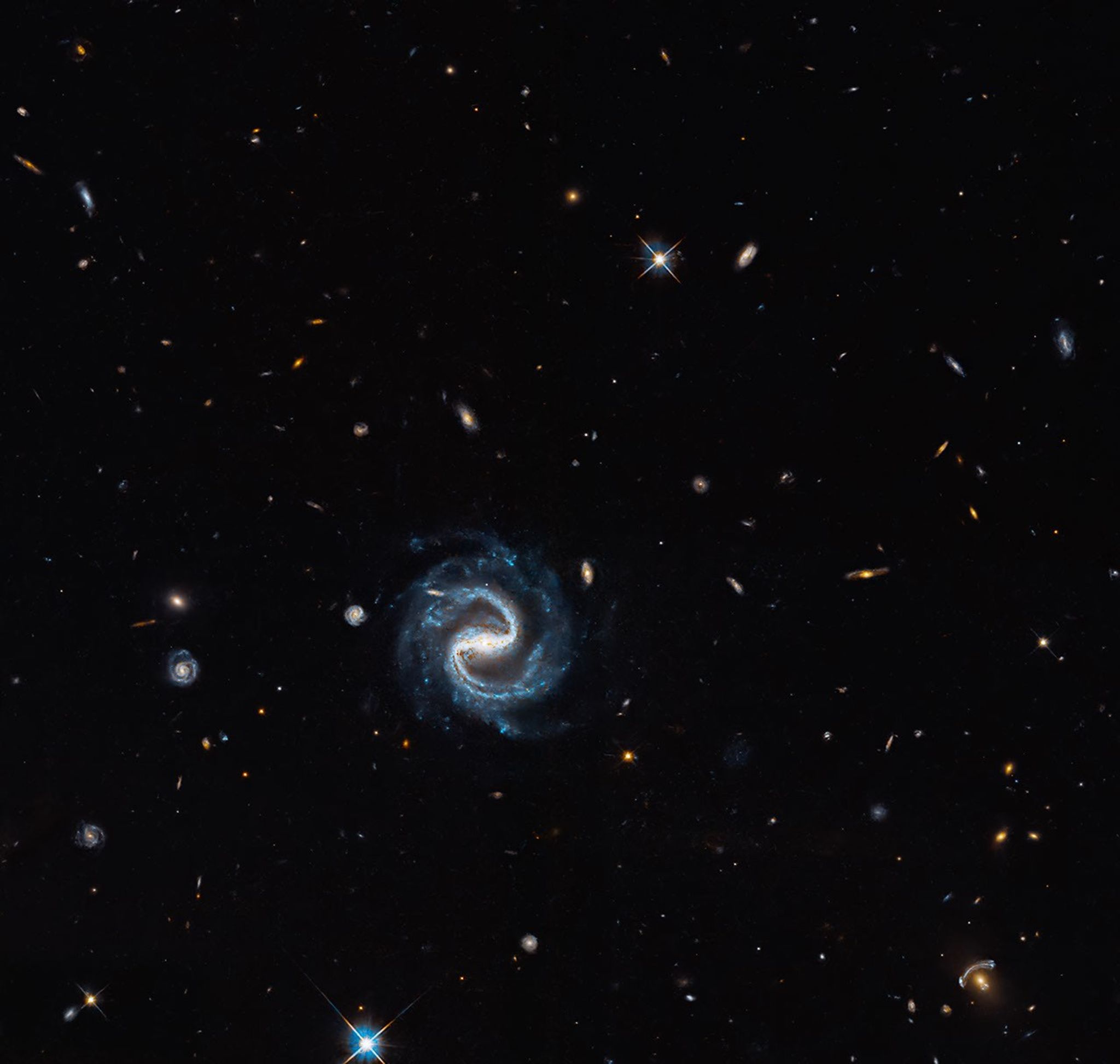
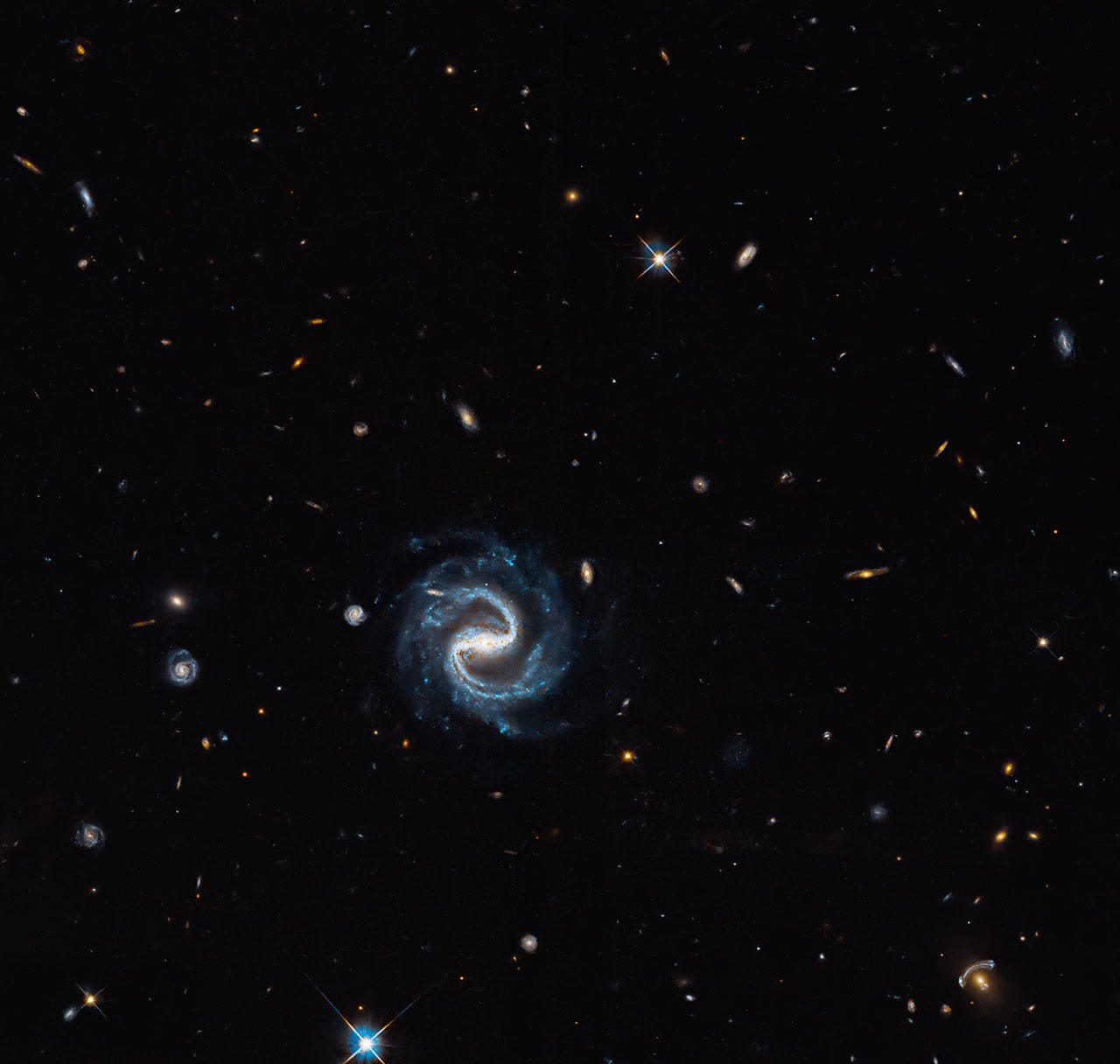
A sweeping barred spiral galaxy marks the spot in this image, but the real treasure is the gravitational lens in the lower-right corner, where a distant background galaxy is being magnified and distorted by the gravity of a closer galaxy.
This observation is one of many gravitational lensing images taken by NASA’s Hubble Space Telescope in preparation for science with the new Nancy Grace Roman Space Telescope.
Gravitational lensing occurs when the mass of a foreground object – such as a galaxy – warps spacetime, causing light to bend, distort, and magnify as it passes around the object, similar to a giant lens in space. Lenses like this occur when a precise chance alignment takes place between the foreground and background galaxies, causing light from the background galaxy to curve around the foreground galaxy.
In this image, the gravitational lens features a foreground elliptical galaxy that is about 4.5 billion light-years away. That means the light we see from this galaxy now would have first started traveling toward us when our solar system was still forming. The background galaxy is about eight billion light-years away, almost twice as far. It appears as a pair of arcs, one large and very noticeable to the upper left of the foreground galaxy, the other a much smaller, flipped image of the same background galaxy to the lower right. This configuration is called an arc-counterarc pair.
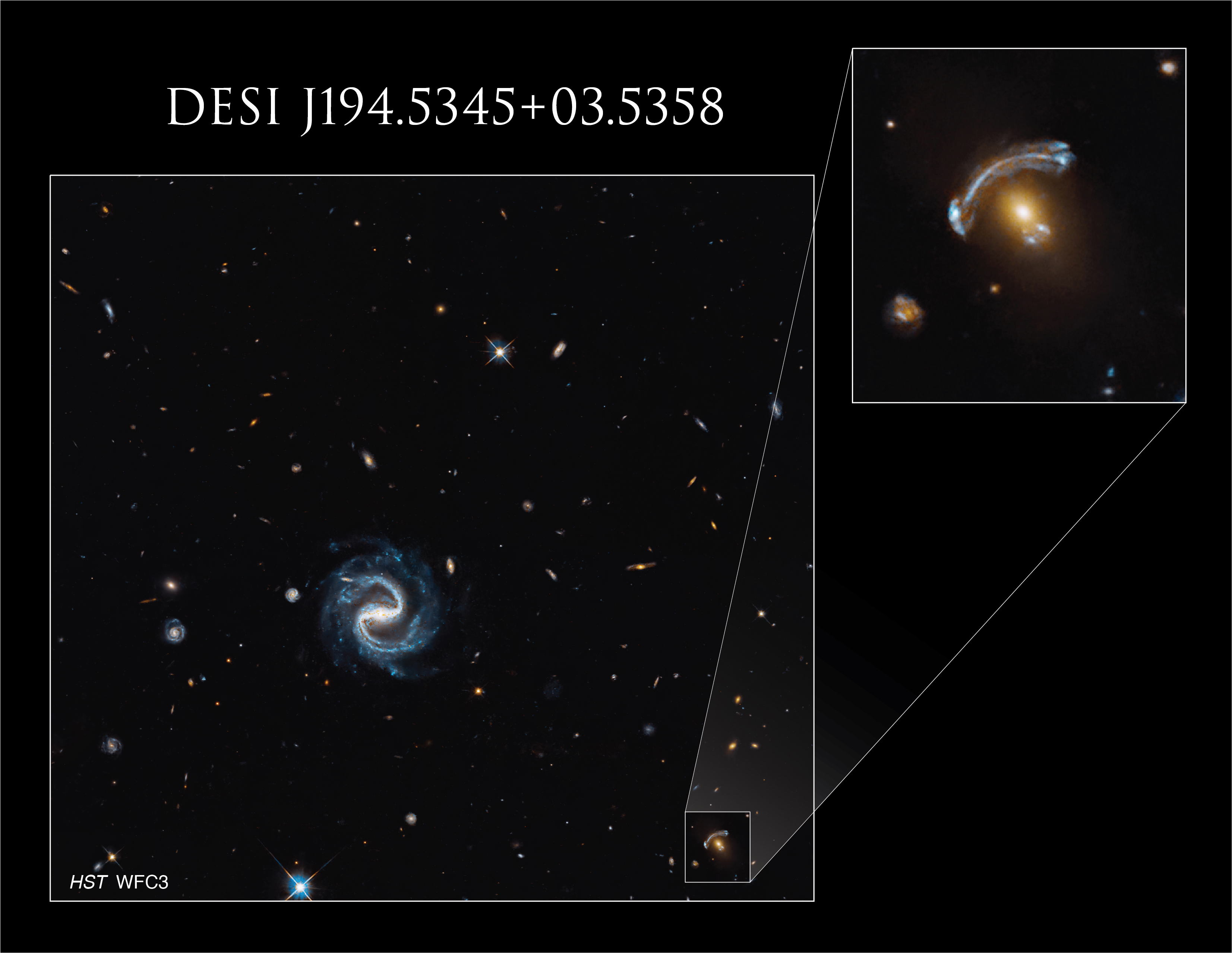
The more massive the foreground galaxy is, the stronger the gravitational lens and the more significantly it bends light. By studying the distortion of the background galaxy, researchers can determine how much mass the foreground galaxy contains. This plays a huge role in the study of dark matter, the mysterious, invisible substance that makes up the majority of mass in the universe. The visible matter is not enough to account for the level of distortion in the background galaxy, which allows researchers to calculate both the mass of the foreground galaxy and how much dark matter it contains.
Almost all of the objects in this image are galaxies, except for a few scattered foreground stars. The barred spiral galaxy in this image – so called because its arms extend from a bar of stars in its center – is about the size of our own Milky Way galaxy, which astronomers think is a barred spiral as well. The tiny spiral to the left of the large spiral may be a satellite galaxy, similar to the Large and Small Magellanic Clouds that orbit the Milky Way.
Hubble views the cosmos primarily in visible and ultraviolet light with some infrared coverage, and Roman sees mainly infrared wavelengths and some visible light. Hubble can provide high-resolution views of individual objects, while Roman has a much larger field of view conducive to panoramas.
Images like this offer a glimpse of how Hubble and Roman will work together to build an even more comprehensive picture of the cosmos. This is just one of many gravitational lens images captured by Hubble. Astronomers will use them to analyze gravitational distortions to learn more about dark matter in the foreground galaxies and to lay the groundwork for future Roman observations.
Hubble can only view these gravitational lenses one at a time, while Roman’s wide view of the sky will provide a greater sample of these lenses. Astronomers are using Hubble’s sharp images to build a computer model to better analyze dark matter-induced distortions. This tool will help astronomers analyze Roman’s large images. Hubble will also follow up on interesting lenses Roman detects.
Explore More
Media Contact:
Claire Andreoli
NASA’s Goddard Space Flight Center, Greenbelt, MD
claire.andreoli@nasa.gov

What's Your Reaction?