








Re-analysis of black hole data proves iconic ring shape really is there
The doughnut shape of the Event Horizon Telescope’s first image of a black hole has come under fire, but an independent check showed that it – and general relativity – still stands

When the Event Horizon Telescope (EHT) team released their first image of a black hole in 2019, the astrophysics community was abuzz: the image of black hole M87* showed a perfect ring structure, just as predicted by the theory of general relativity. As other teams reanalysed the data in the following years, though, scepticism about the image began to slip in. A new, completely independent analysis has now finally banished that scepticism.
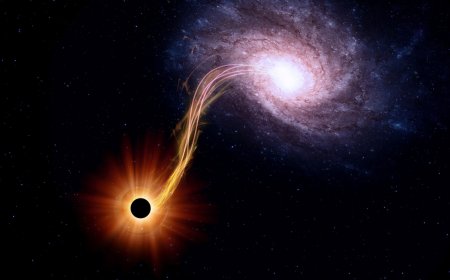
The now-iconic doughnut shape of the EHT image is caused by a key property of general relativity, the way that light bends in the presence of an extremely massive object. Observing it for real was one of the strongest pieces of evidence that general relativity is accurate.
What allowed us to finally capture the image was the unique structure of the EHT, which is made up of a network of telescopes all around the world, used as one Earth-sized radio dish. This allows it to peer much closer to the edge of a black hole than any other observatory. However, the same structure that enabled the image also limits the EHT. “It has only a handful of telescopes spread across the globe, which leaves large gaps in its measurements that the imaging algorithm has to fill in,” says Nithyanandan Thyagarajan at CSIRO in Australia. “It also observes at very short radio wavelengths, where the atmosphere can distort the signal.”
Advertisement
These limitations mean that the raw data from the EHT is more subject to interpretation than most astronomical observations, and the way the data is processed is particularly impactful on the final image. Most of the analyses of the M87* data produced similar ring shapes, but one that was published in 2022 found no ring at all.
So, when Thyagarajan and his colleagues reanalysed the data, they developed an entirely new data pipeline to do so. Instead of analysing the data from pairs of EHT telescopes before combining them, which is the standard method, they grouped the telescopes into triplets.

“By combining measurements from sets of three telescopes, we preserve the information about the object’s shape while cancelling out errors from the atmosphere and the telescopes,” says Thyagarajan. They also developed a machine learning algorithm trained on non-black-hole images to minimise bias from their own expectations of what the image might look like.
In the end, their new image is nearly identical to the original. This is a key confirmation of the EHT’s finding that general relativity truly does describe the space-time around a black hole accurately.
What's Your Reaction?