











Clothes made from living fungi can clean and repair themselves
Researchers have created a textile made from the parasitic fungus Cordyceps militaris, which is biodegradable and can be adapted for different purposes with various microbes

A parasitic fungus that grows on caterpillars has been turned into a dress designed to be able to repair itself if damaged.
In the video game and TV series The Last of Us, Cordyceps fungi evolve to infect humans and turn them into zombies, but in reality they are harmless to humans.
Using the fungus Cordyceps militaris as a base, Ke Li at the Chinese Academy of Sciences and her colleagues created a living textile that can be “programmed” with different properties using various microbial components.
Advertisement
It feels denser and less fibrous than cotton, says Li, and is closer to a soft, non-woven sheet or a flexible leather-like material.
“After washing and processing, the material does not have a strong mushroom-like smell,” she says. “A slight biological or fermentation-related odour may be detectable in freshly prepared samples, but this can be greatly reduced through cleaning, drying and post-treatment.”

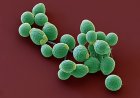
The fungus is made up of thin filaments known as hyphae. Li and her colleagues first grew the fungus as small, spherical pellets in liquid culture, then washed them and placed them into moulds where they formed a sheet.
To prevent the resulting textile from becoming brittle, it was soaked in glycerol, which acts as a “plasticiser”, making the naturally rigid fungal structure softer and more flexible.
“We do not use a conventional fabric, polymer mesh or other external supporting scaffold,” says Li. “The Cordyceps militaris mycelial pellets themselves serve as the structural building blocks, and their intertwined hyphae form a continuous, self-supporting sheet.”
To add colour to the material, the team introduced yeast cells that were engineered to produce orange, blue and purple pigments. “These cells can be applied to the fungal textile so that the colour is generated biologically, rather than through conventional synthetic dyes,” says Li.
The researchers also showed they could change the properties of the textile by adding other fungi, for example making it clean itself by repelling water droplets. For UV protection, they added Aspergillus niger, a mould that commonly grows on fruit and vegetables. This forms a dark layer on the surface of the material containing melanin pigment, which absorbs ultraviolet radiation.
If the textile is damaged, then fresh, wet fungal pellets can be applied to the area that needs repair and the fungus simply grows over the breach.
Under dry conditions, most biological activity is greatly reduced, and the cells may remain inactive or dormant, says Li.
But under humid conditions with nutrients present, some cells can become active again. This latent biological capacity is what enables functions such as regrowth and repair, and also means that the material is readily biodegradable, showing near-complete visible degradation in soil after just over 40 days.
Li and her colleagues created a dress out of their fungal material, but so far no one has worn it. “We’ve treated it as a rather precious display piece, and it was made in a small size,” she says. “Perhaps next time we should find a few petite and adventurous volunteers to try it on and see how it looks in motion.”
Justin Beardsley at the University of Sydney, Australia, says the biodegradability of the dress is amazing compared with what we currently have in terms of getting rid of waste from fast fashion.
But that is also a drawback because you don’t really want to be wearing something that is too easily biodegradable, as “it’ll break down while you’re wearing it”, he says.
As the textile is alive, Beardsley envisages one day being able to change its qualities in real time. “If there was some way that you can make it water-repellent for a while, becoming less breathable during rain, that would be fantastic, and then you can revert to the more breathable, less water-repellent version afterward,” he says.
Science Advances: DOI: 10.1126/sciadv.aed6937
What's Your Reaction?