









Fastest star ever spotted at the centre of our galaxy
A newfound star called S301 is both the fastest ever seen and the closest to a supermassive black hole –and it could make bafflingly difficult tests of gravity possible at last

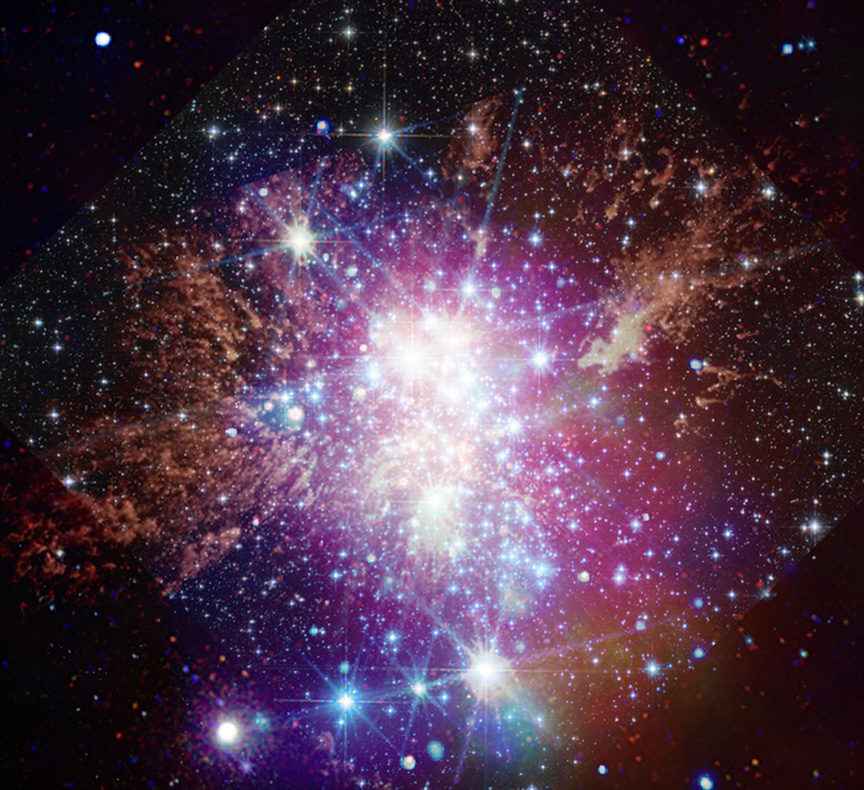
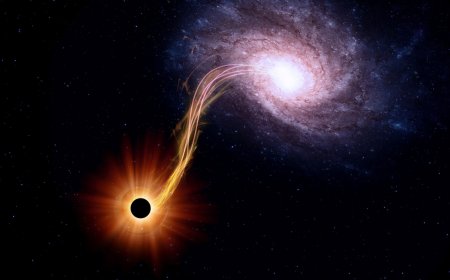
A star near the centre of the Milky Way is hurtling through its orbit with a peak speed of more than 8 per cent the speed of light, making it both the fastest star and the closest to a supermassive black hole that has ever been spotted. Named S301, this astonishing star could help us unravel the secrets of gravity.
Stefan Gillessen at the Max Planck Institute for Extraterrestrial Physics in Germany and his colleagues found S301 using the Very Large Telescope in Chile. They have been watching it since 2023 to get enough data to pin down its orbit, and the results are unprecedented.
At its closest approach, S301 is only about 1.8 billion kilometres from Sagittarius A*, the supermassive black hole at the centre of our galaxy. That’s just 12 times the distance between Earth and the sun, 10 times closer to Sagittarius A* than the previous record-holder. “If you were living on a planet around this star, the size of the black hole at the closest approach would appear similar to the full moon from Earth – it would be absolutely stunning,” says Gillessen.
Advertisement
Such a close pass by the black hole means that S301 spends part of its orbit in one of the most extreme gravitational environments in the universe. Next to a black hole, space-time stretches and warps. If a black hole is spinning, it should warp space-time even more, twisting it up in what is known as the frame-dragging effect.
“Earth does this as well, and we can measure with satellites around Earth that there is a very, very slight frame dragging from Earth’s rotation,” says Tuan Do at the University of California, Los Angeles, who wasn’t involved in the research. “This is doing the same thing, just with much different objects.”

Measuring Earth’s spin is relatively easy, but a black hole’s spin is much harder to determine because of its lack of a visible surface. The most precise way to measure it would be by measuring frame dragging, and S301 is the first star close enough to feel that effect.
“We drop a leaf in the wind and see how the air is moving by measuring that leaf,” says Gillessen. “A star is just the perfect leaf to drop to see the movement of space-time.”
Actually measuring the spin of Sagittarius A* using this method will probably take around a decade, he says, but that may speed up if we find more stars like it.
“With one star, it would take a while, but it would still be the best constraint on spin that we’ve ever had by far,” says Ziri Younsi at University College London. “If you can find another star that’s even closer, that’s better still. If you can find a population of these stars, then you’re in business.”

Gillessen and his team have several candidates for stars slightly further from the black hole than S301, but none yet that are closer, he says.
But when we finally do measure the spin of a black hole, it will be a crucial piece of the cosmic jigsaw. It will not only help us understand how black holes have contributed to the evolution of the universe, but will also provide a probe into the behaviour of gravity in extreme environments, which has proved extremely difficult to study.
“A black hole only has three measurable properties: a mass, a spin and possibly an electric charge. The mass was worth a Nobel prize in 2020, so, if you find the spin, you might expect a call from Stockholm in 20 years,” says Gillessen.
What's Your Reaction?