















Human organoids restore cognition in mice with half a brain
Mice with half a brain experienced significant improvements to their cognition and movement when they received brain organoids made from human stem cells

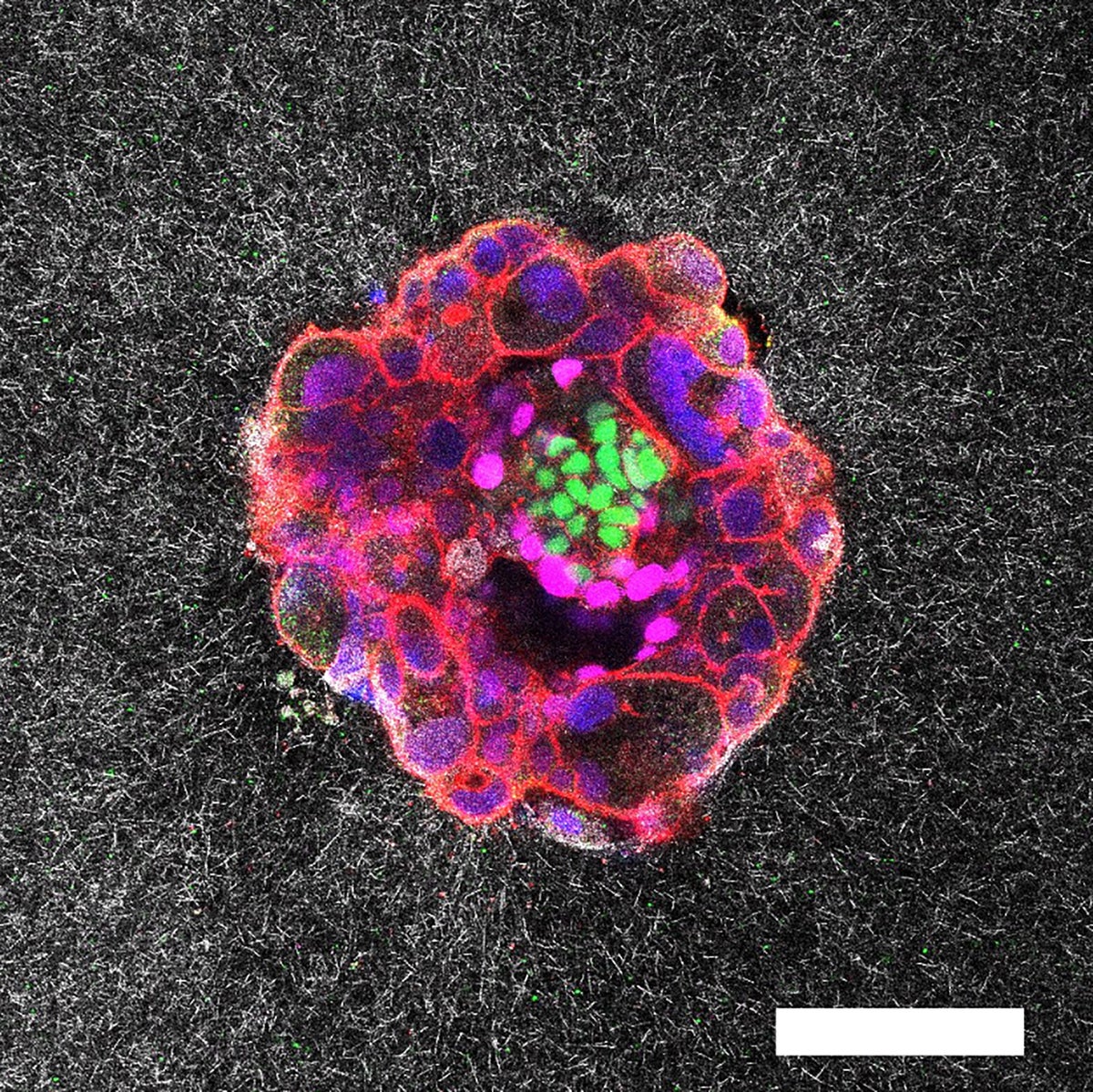
Human brain organoids have been implanted into mice that are missing half their brain. Tiny versions of the human cerebral cortex – a region involved in memory, movement and thinking – were put into mice that lacked this major brain region. Not only did the organoids integrate into the mice’s brains, they also restored most of their cognition.
“The mouse is [relatively] sick without a cortex, then you transplant these organoids in, and it behaves more like the normal mouse,” says Gabriel Balmuș at the University of Cambridge, who wasn’t involved in the research.
Sergiu Pașca at Stanford University in California and his colleagues genetically engineered mice to lack more than 90 per cent of their cortex, or about half their brain. These mice only experience some memory and movement deficits, since their brain adapts to compensate for their missing cortex, says Pașca.
Advertisement
In about half of these mice, the team surgically implanted four human brain organoids, generated by bathing human stem cells in chemicals for about 40 days. These filled the cavity in each of the mice’s skulls, producing what the researchers called XCX mice. The remaining mice, apallial mice, didn’t receive the transplants.

A few months later, the apallial mice performed worse in a memory test, where they had to navigate a maze, than a third group of normal mice. But this deficit was almost completely reversed in the XCX mice. The XCX mice also had a gait between that of the apallial and normal mice.
Scans revealed that the organoids had grown to form cortex-like grafts. “Half the volume of the brain is [initially] gone, and now largely 90 per cent of that missing volume is covered by human cells,” said Pașca.
This builds on prior studies that have implanted human brain organoids into rat or mouse brains, but without such a large part of the rodent brain being missing initially, says Pașca. These studies only showed that such organoids can alter cognition, rather than improving it, he says. For instance, in one study, light stimulated human brain organoids in rats to make them anticipate water.

The grafts in the latest study were also the first to contain a kind of nerve cell, called von Economo neurons, that influences social skills, as well as neurons that extended from the cortex to the spinal cord. The latter could explain why these grafts reduced impairments in motor skills, says Balmuș.
The team’s organoids were larger and more akin to the human cerebral cortex than those used in previous experiments, says Pașca. But according to Jürgen Knoblich at the Institute of Molecular Biotechnology in Vienna, Austria, they still lack the proper arrangement and structure of the cortex. “It’s a bit of a mishmash of neurons” and other cells, he says. “Most of the cell types are there but they’re not separated into regions like in a normal cortex.”
In another experiment, the team showed that human organoid transplants made mice respond to hypoxia, or low oxygen levels, in a similar way to people. Mice have evolved to be highly resilient to low oxygen levels, due to living underground, so it’s hard to replicate this in a normal mouse, says Balmuș. This suggests that these experimental animals could provide a better way to study cerebral palsy, a condition that causes movement problems and can be caused by hypoxia around birth, says Balmuș.
But such experiments come with ethical concerns, says Knoblich. These mice “deserve the same kind of protection that we ascribe to any animal experiment, meaning that we need to make absolutely sure that there’s no sensation of pain, that there is no unnecessary suffering, and that the risk of the experiment is matched to the medical gain,” he says. The latest study achieved this, he says.
A common concern is whether mice with human brain organoids will gain a human-like level of consciousness. “The data so far doesn’t say that that putting [a human organoid] in makes the mouse smarter or more conscious than a normal mouse,” says Knoblich. “It’s similar to taking a wheel from a car and putting it on a tree and saying that’s a car.”
What's Your Reaction?