
















NASA’s Artemis II Moon Mission Daily Agenda
About eight minutes after Artemis II lifts off, the Orion spacecraft and its crew, NASA astronauts Reid Wiseman, Victor Glover, and Christina Koch, along with CSA (Canadian Space Agency) astronaut Jeremy Hansen, will be in space. The approximately 10-day test flight will be packed with activity as the astronauts venture around the Moon and back, […]
About eight minutes after Artemis II lifts off, the Orion spacecraft and its crew, NASA astronauts Reid Wiseman, Victor Glover, and Christina Koch, along with CSA (Canadian Space Agency) astronaut Jeremy Hansen, will be in space. The approximately 10-day test flight will be packed with activity as the astronauts venture around the Moon and back, with teams checking out Orion’s systems along the way. While teams in mission control could refine the crew’s schedule each day based on operational activities during the test flight, ground teams and the crew have a general plan for each day of the mission.
Launch Day/Flight Day 1:
Once the SLS (Space Launch System) rocket’s main engines cutoff, Orion and the interim cryogenic propulsion stage (ICPS) separate from the rest of rocket. The ICPS still has work to do – about 49 minutes after launch, its engine will fire to raise the perigee, or lowest point of a spacecraft’s orbit, to a safe altitude of 100 miles above Earth. About an hour later, when Orion reaches that perigee, the ICPS will fire again to continue raising the spacecraft into a high-Earth orbit. The crew will then have about 23 hours to do a thorough checkout of Orion’s systems while still relatively close to home.
The crew will start testing systems like the potable water dispenser that will provide drinking water and rehydrate the food they brought along, the toilet, and the system that removes carbon dioxide from the air. The crewmates also can take off the orange spacesuits worn for launch and work in regular clothing. They’ll spend time rearranging Orion’s interior to function as a living and workspace for four floating people over the next 10 days.
About three hours into the mission, NASA will test how Orion handles.
On future missions, Orion will dock with other spacecraft. To verify Orion will do so safely, the ICPS will be repurposed as a docking target. It will separate from Orion, and the crew will practice flying their spacecraft toward and around it in a proximity operations demonstration. Afterward, the ICPS will fire its engines again for a disposal burn that will send it into the Pacific Ocean, and Orion will continue its high Earth orbit.
After about eight-and-a-half hours in space, the astronauts will sleep for a short period. The four astronauts will be awakened after about four hours to perform an additional engine firing that will put Orion into the correct orbital geometry for its translunar injection (TLI) burn on flight day 2. They’ll also take the opportunity to perform a brief check out of their emergency communications on the Deep Space Network, at the most-distant point of their high Earth orbit, which is necessary before the TLI.
After this, they’ll be able to go back to sleep for another four-and-a-half hours, wrapping up flight day 1.
Flight Day 2
Wiseman and Glover will begin their day setting up and checking out Orion’s flywheel exercise device before getting in their first workouts of the mission. Koch and Hansen have exercise scheduled for the second half of the day. The morning workouts will provide another test of Orion’s life support systems before leaving Earth orbit.
Koch will spend her morning preparing for the main event of the day – the translunar injection burn. The TLI is the last major engine firing of the Artemis II mission and will set Orion on the path to the Moon. And since Orion is using a free-return trajectory to swing around the far side of the Moon, the TLI engine firing also puts Orion on the path to return to Earth on flight day 10.
Koch will set up Orion’s system to perform the burn, done by Orion’s main engine on the spacecraft’s European Service Module. Also called the orbital maneuvering system engine, it provides up to 6,000 pounds of thrust – enough to accelerate a car from 0 to 60 mph in about 2.7 seconds.
Following TLI, the crew has a lighter day of activity, with time set aside to acclimate to the space environment. They’ll have an opportunity to participate in a space to ground video communication – the first of several that will take place throughout the mission. With the exception of flight day 7 – the crew’s off-duty day – and landing day, they are expected to have one or two of these opportunities each day of the mission.
Flight Day 3
The first of three smaller engine firings, called the outbound trajectory correction, will ensure Orion is staying on target for its path around the Moon and will take place on flight day 3. Hansen will prepare for the burn in the morning, which is scheduled to happen shortly after the crew’s midday meal.
The rest of the day will include a variety of checkouts and demonstrations. Glover, Koch, and Hansen will demonstrate CPR procedures in space; Wiseman and Glover will checkout some of Orion’s medical kit, including the thermometer, blood pressure monitor, stethoscope, and otoscope.
Koch has time set aside in the second half of the day to test Orion’s emergency communications system on the Deep Space Network. The entire crew will come together to rehearse the choreography for the scientific observation work they’ll do on flight day 6, when Orion comes the closest to the Moon.
Flight Day 4
A second outbound trajectory correction burn on flight day 4 will continue to refine Orion’s path to the Moon as the crew perfects some of their own preparations. They’ll each have an hour devoted to reviewing the geography targets they’ll be asked to get imagery of on flight day 6. Since those will vary depending on the crew’s final launch time and day, this serves as an opportunity to study exactly what they’ll be looking for as they draw close to the lunar surface. Although they will likely take photos and video out of Orion’s windows often, flight day 4 has 20 minutes on the schedule specifically dedicated to taking photos of celestial bodies from Orion’s windows.
Flight Day 5
Orion will enter the lunar sphere of influence on flight day 5, marking the point at which the pull of the Moon’s gravity will become stronger than the pull of the Earth’s gravity.
As they enter the Moon’s neighborhood, the crew will have a full day, with the morning almost entirely devoted to tests of their spacesuits. Officially called the Orion crew survival system, the orange suits protect the crew during launch and reentry, but also could be used in an emergency to provide the crew member wearing it with a breathable atmosphere for up to six days if Orion depressurized. As the first astronauts to wear the new suits in space, the Artemis II crew will be testing their ability to quickly put the suits on and pressurize them; install their seats and get into them while wearing the suits; eat and drink through a port on the spacesuits’ helmet; and other functions.
During the crew’s afternoon, the final outbound trajectory correction burn will take place before Orion’s lunar flyby on flight day 6.
Flight Day 6
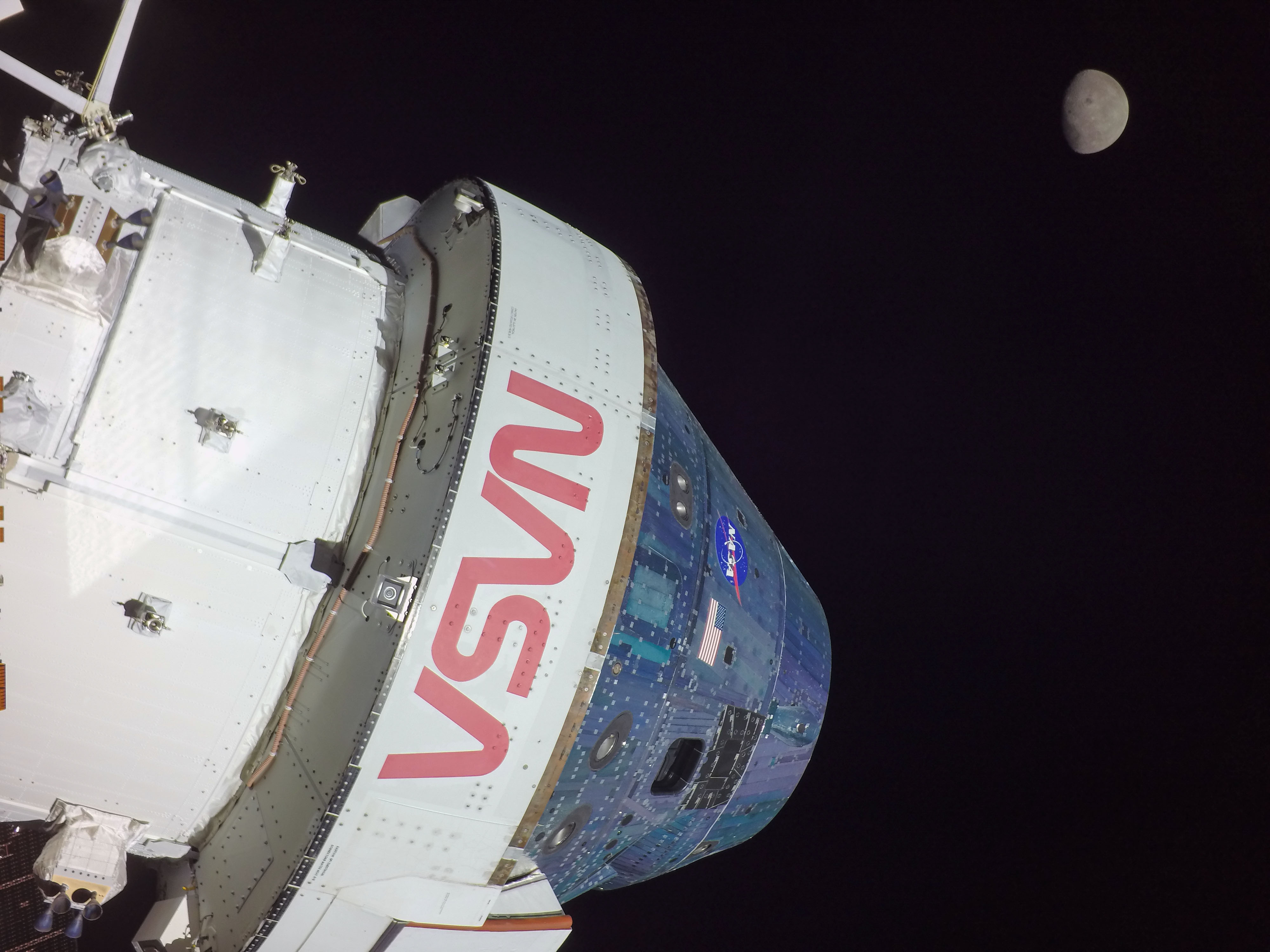
The Artemis II crew will come their closest to the Moon on flight day 6, while traveling the farthest from Earth. Artemis II could set a record for the farthest anyone has traveled from Earth depending on launch day, breaking the current record – 248,655 miles away – set in 1970 by the Apollo 13 crew. The distance the Artemis II crew will travel depends on their exact launch day and time.
Over the course of the day, the crew will come within 4,000 to 6,000 miles of the lunar surface as they swing around the far side of the Moon – it should look to them about the size of a basketball held at arm’s length. They will devote the majority of their day to taking photos and videos of the Moon, and recording their observations as they become the first to see some parts of the Moon with their own eyes.
Because the Sun’s angle on the Moon changes by about one degree every two hours, the crew won’t be sure what lighting conditions to expect on the lunar surface until they launch. If the Sun is high in the lunar sky during the flyby, there will be few shadows, and the crew will be looking for subtle variations in surface color and rightness. If the Sun is lower on the horizon, long shadows will stretch across the surface, enhancing relief and revealing depth, ridges, slopes, and crater rims that are often difficult to detect under full illumination. If the Sun is overhead from Orion’s perspective – like noon on Earth – shadows will be few to nonexistent, creating ideal lighting conditions for close-up imaging of specific lunar features.
The crew will record their observations in real time, as they take photos and videos – including when they lose communication with Earth for 30-50 minutes as they pass behind the Moon. That way, their observations can later be linked with the exact images they took.
Flight Day 7
Orion will exit the lunar sphere of influence the morning of flight day 7. Before the Artemis II crew gets too far away from the Moon, scientists on the ground, eager to hear from them while the experience is still fresh in their minds, will have time to speak with the crew.
In the second half of the crew’s day, the Orion engine will fire again for the first of three return trajectory correction burns that will adjust Orion’s path home.
The rest of the day will be largely off-duty for the crew, giving them a chance to rest before jumping back into their final tasks before their return to Earth.
Flight Day 8
The primary activities for flight day 8 include two Orion demonstrations.
First, the crew will assess their ability to protect themselves from high radiation events like solar flares. They’ll use Orion’s supplies and equipment to build a shelter for cover if needed. Radiation will be an ongoing concern as humans venture into deep space, and multiple experiments will be aimed at collecting data on the radiation levels inside Orion.
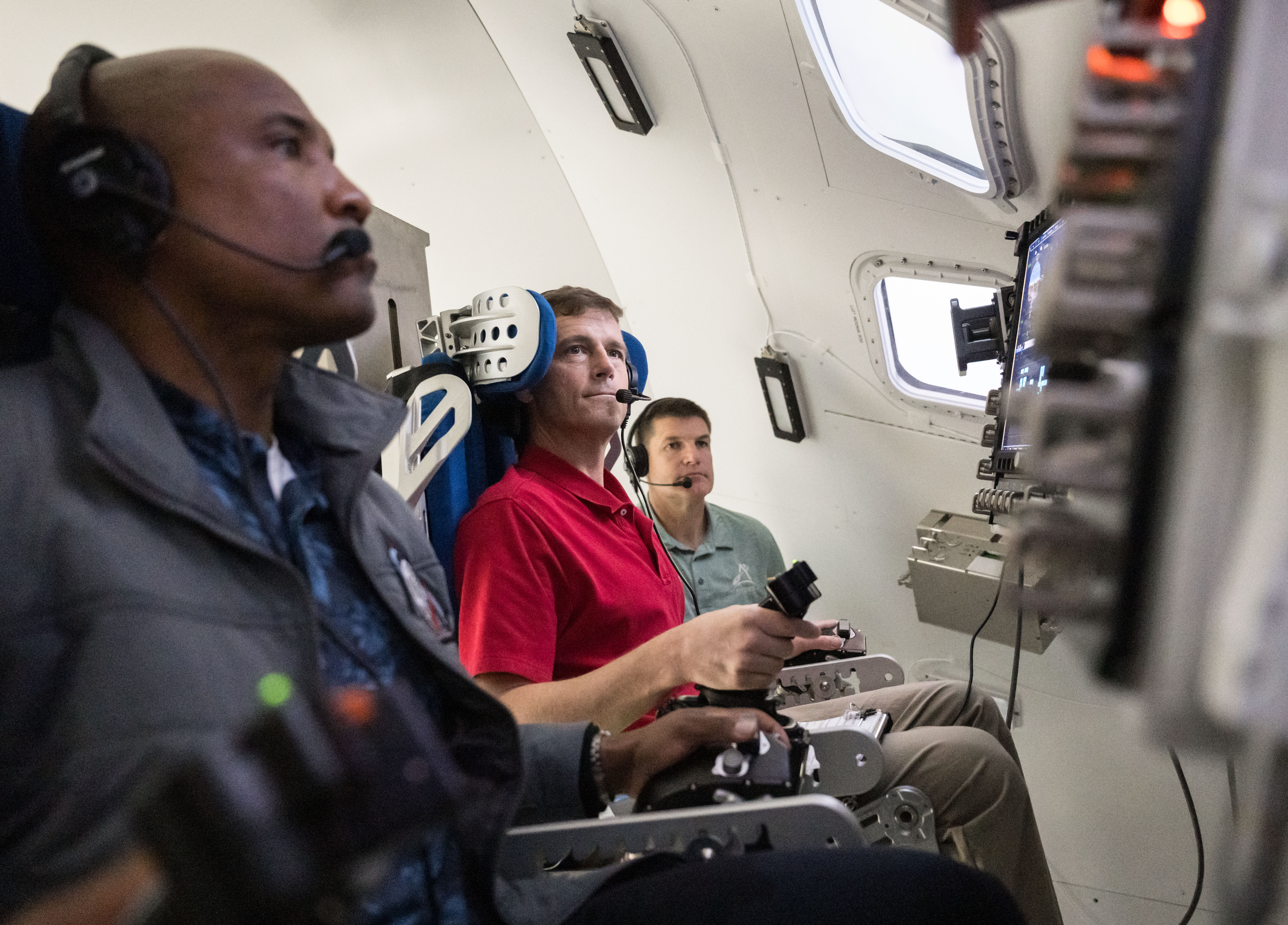
At the end of the day, the crew will try out Orion’s manual piloting capability by steering the spacecraft through a variety of tasks. They’ll center a chosen target in Orion’s windows, move into a tail-to-Sun attitude, and perform attitude maneuvers comparing the craft’s six-degree-of-freedom and three-degree-of-freedom attitude control modes.
Flight Day 9
Artemis II’s last full day in space will kick off with prep for their return to Earth. The crew has time set aside to study their procedures for reentry and splashdown, and talk with the flight control team. Another return trajectory correction burn will ensure the spacecraft remains on target for that return.
The crew will complete more demonstrations to check off their to-do list: waste collection systems in case the Orion toilet doesn’t function properly and orthostatic intolerance garment fit checks. Orthostatic intolerance – which can cause symptoms such as dizziness and lightheadedness while standing – is a possibility for astronauts when they return to Earth and their bodies must readapt to the pull of gravity on their blood supply. Compression garments, worn under spacesuits, can help.
The crew members will try their garments on, take body circumference measurements, and complete a questionnaire on how it fits, and how easy it is to put on and take off.
Flight Day 10
The last day of the Artemis II mission is focused on getting the crew safely home. A final return trajectory correction burn will ensure Orion is on the right path for splashdown, and the crew will return their cabin to its original set up – with equipment stowed and seats in place – and get back into their spacesuits.
The crew module will separate from the service module, whose engines have steered them around the Moon and back to Earth. This will expose the crew module’s heat shield, which will protect the spacecraft and crew as they make their way back through Earth’s atmosphere and temperatures of up about 3,000 degrees Fahrenheit. Once safely through the heat of reentry, the cover that protected the spacecraft’s forward bay will be jettisoned to make way for a series of parachutes to deploy – two drogue parachutes that will slow the capsule down to about 307 miles per hour, followed by three pilot parachutes that will pull out the final three main parachutes. These will slow Orion down to approximately 17 mph for a splashdown in the Pacific Ocean, where NASA and U.S. Navy personnel will be waiting for them, concluding the Artemis II mission.
What's Your Reaction?