










NASA’s Fermi Glimpses Power Source of Supercharged Supernovae
An international team studying data from NASA’s Fermi Gamma-ray Space Telescope concludes the mission detected a rare, unusually luminous supernova. The researchers say it likely received its power-up from a supermagnetized neutron star born in the stellar collapse that triggered the explosion. The Fermi mission is part of NASA’s fleet of observatories monitoring the changing […]
5 min read
NASA’s Fermi Glimpses Power Source of Supercharged Supernovae
An international team studying data from NASA’s Fermi Gamma-ray Space Telescope concludes the mission detected a rare, unusually luminous supernova. The researchers say it likely received its power-up from a supermagnetized neutron star born in the stellar collapse that triggered the explosion.
NASA’s Goddard Space Flight Center
The Fermi mission is part of NASA’s fleet of observatories monitoring the changing cosmos to help humanity better understand how the universe works.
“For nearly 20 years, astronomers have searched Fermi data for gamma-ray signals from thousands of supernovae, and while a few intriguing hints have been reported, none were definitive until now,” study lead Fabio Acero at the French National Centre for Scientific Research (CNRS) and the University of Paris-Saclay.
A paper describing the findings published Wednesday in the journal Astronomy & Astrophysics.
Core-collapse supernovae occur when the energy-producing center of a star many times our Sun’s mass runs out of fuel, collapses under its own weight, and explodes. During the collapse, a city-sized neutron star or an even smaller black hole may form. A blast wave blows away the rest of the star, which rapidly expands as a hot, dense cloud of ionized gas.
In the last couple of decades, nearly 400 exceptional core-collapse supernovae have been identified. Each of these events, dubbed superluminous supernovae, produced 10 or more times the amount of visible light normally seen.
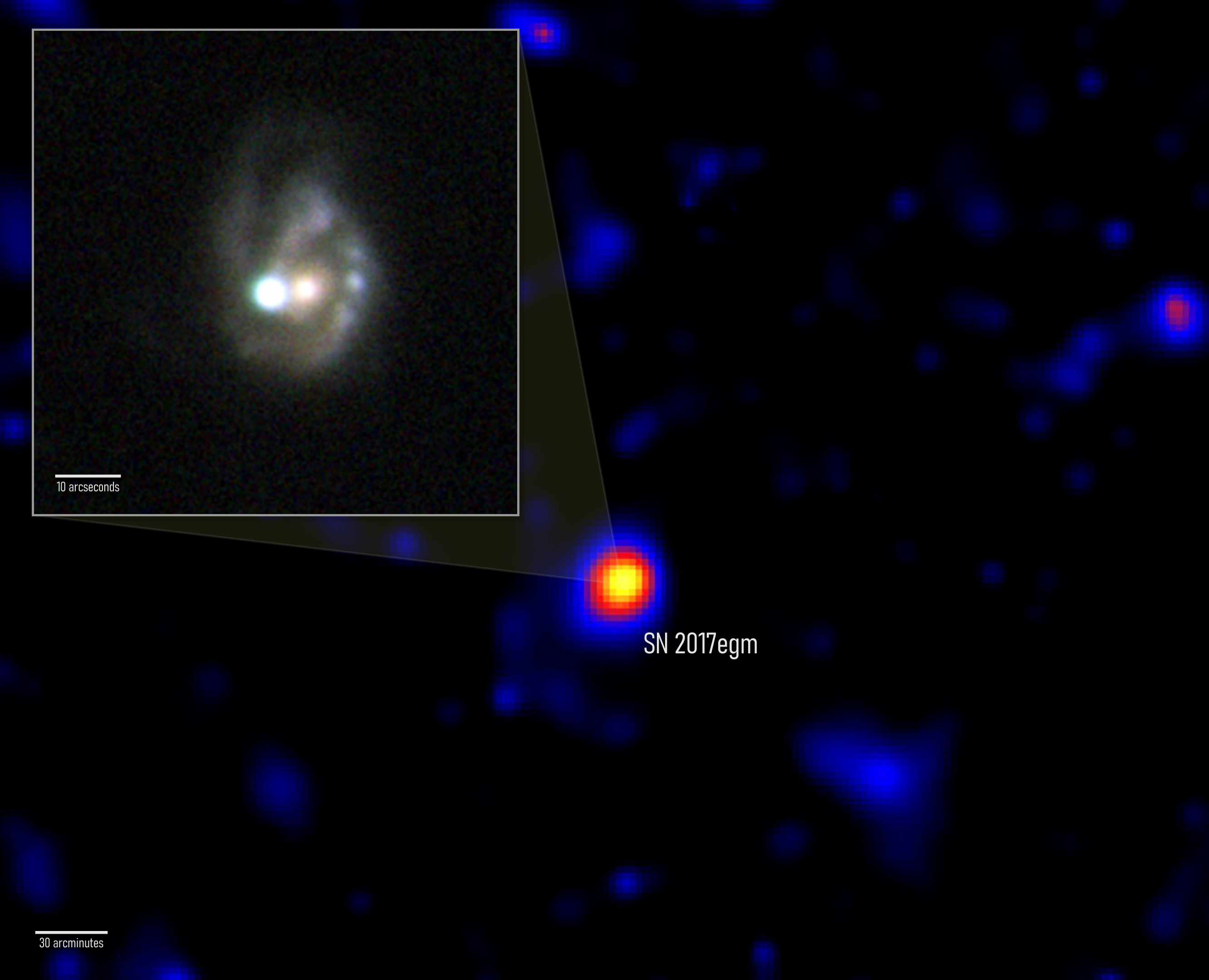
In 2024, a study led by Li Shang at Anhui University in Hefei, China, noted that Fermi’s Large Area Telescope may have seen gamma rays — the most energetic form of light — from a superluminous supernova that occurred years earlier.
Dubbed SN 2017egm, this supercharged outburst occurred in galaxy NGC 3191, located about 440 million light-years away in the constellation Ursa Major. Even at this distance, the explosion remains one of the closest of its type to us on Earth.
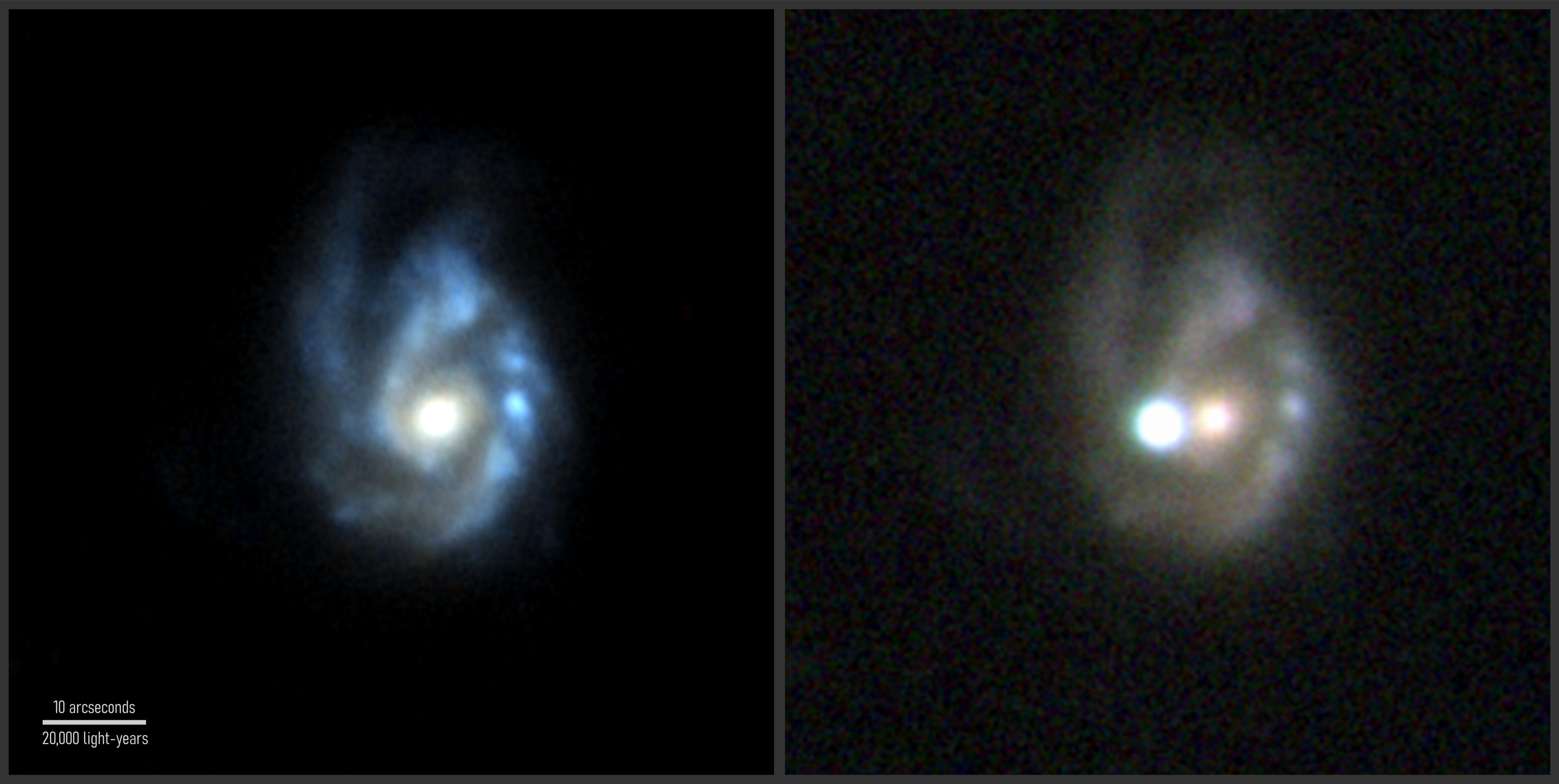
“We searched for gamma rays from the six nearest superluminous supernovae seen during the first 16 years of Fermi’s mission,” said Guillem Martí-Devesa, a researcher previously at the University of Trieste in Italy and now a fellow at the Institute of Space Sciences in Barcelona, Spain. “Only SN 2017egm shows evidence for gamma rays, confirming earlier hints that some supernovae can be as luminous in gamma rays as they are in visible light. This opens up a new window for studying these fascinating events.”
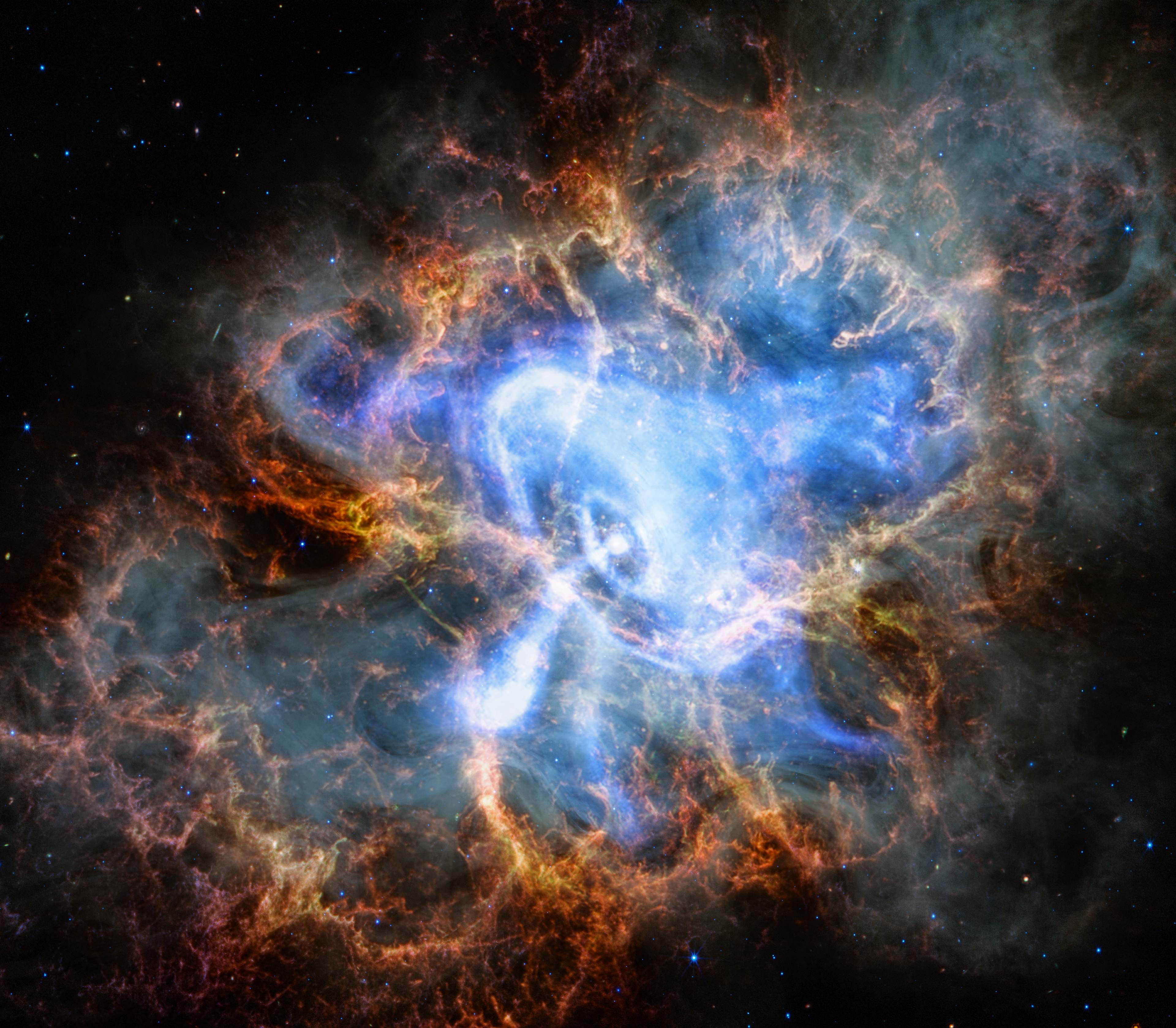
Theorists have debated the possible energy sources that give these explosions their extra punch. High on the list has been the formation of a magnetar, a type of neutron star with the strongest magnetic fields known — up to 1,000 times the intensity of typical neutron stars. That’s 10 trillion times stronger than a refrigerator magnet.
The team undertook a deeper analysis of the supernova’s observed optical and gamma-ray features to compare how well different theoretical models reproduced them. A model developed by co-authors Indrek Vurm at the University of Tartu in Estonia and Brian Metzger at Columbia University in New York City traced how light and particles produced by a newborn magnetar would move outward and interact with the supernova’s expanding debris.
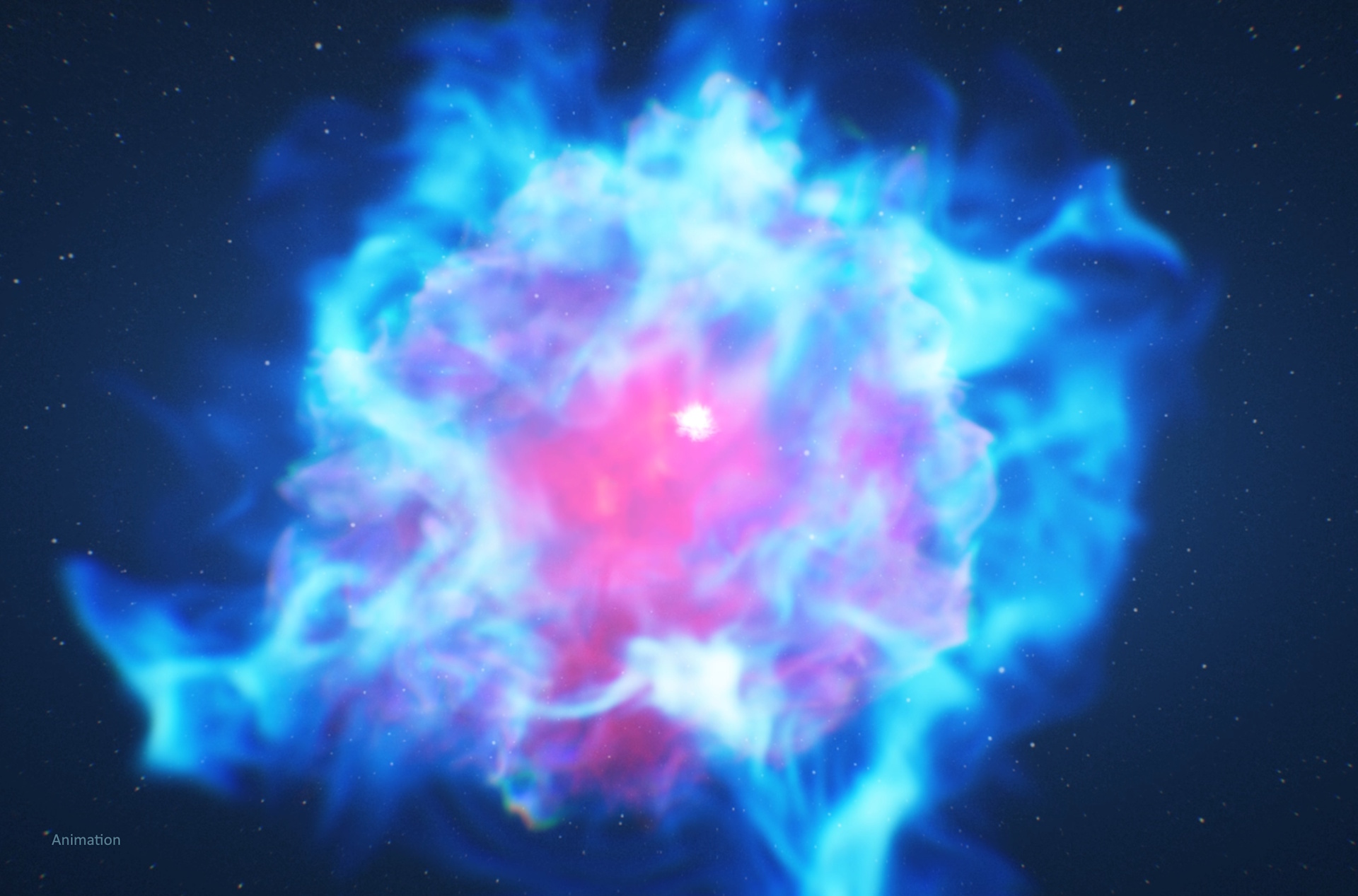
Scientists expect a newly formed magnetar to spin a few hundred times a second. This rapid rotation produces a strong outflow of electrons and positrons, their antimatter counterparts, that forms a vast cloud of energetic particles.
Within this cloud — called a magnetar wind nebula — various interactions fuel the production and absorption of gamma rays. For example, an electron and a positron can annihilate into a pair of gamma-ray photons, or two gamma rays can collide and produce the particles. In these and other ways, gamma rays interact with the supernova debris. Unable to escape directly, they become reprocessed, downshifted into lower-energy visible light that provides the supernova with its extra boost in luminosity.
“About three months after the collapse, as the supernova debris expands and cools, the gamma rays can begin to leak out,” Acero said. “This magnetar model best reproduces the supernova’s luminosity and the arrival time of its gamma rays during the first months, but we see room for improvement at later times, when the visible light fades quite irregularly.”
Acero and his colleagues suggest that additional processes likely played contributing roles during SN 2017egm’s long fade-out. These include debris falling back onto the magnetar and interactions between the blast wave and matter ejected by the star in the centuries prior to its demise.
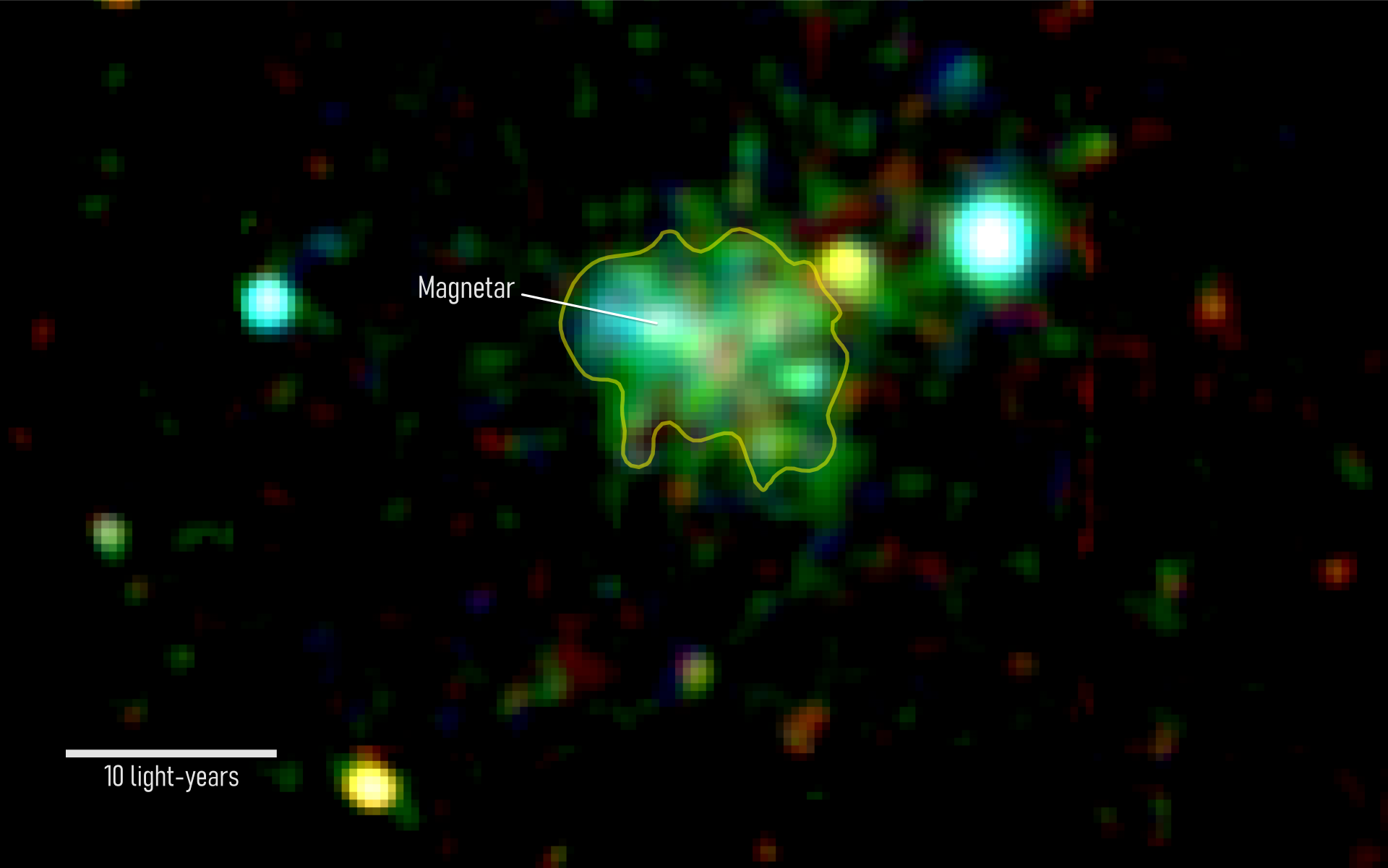
The team also examined how well a new ground-based gamma-ray facility, the Cerenkov Telescope Array Observatory, might detect events like SN 2017egm. With about 50 hours of observing time, they say, a similar supernova could be detected out to about 500 million light-years. Our understanding of phenomena like SN 2017egm will improve thanks to cooperation between such facilities and NASA’s fleet of space-based observatories that watch for rapid changes in the universe.
“The magnetar central engine mechanism discussed in this paper builds upon a lot of observational and theoretical advances in magnetars over the last 20 years,” said Judy Racusin, a deputy project scientist for the Fermi mission at NASA’s Goddard Space Flight Center in Greenbelt, Maryland. “Observing gamma rays from supernovae will give us a new way to explore their inner workings.”
By Francis Reddy
NASA’s Goddard Space Flight Center, Greenbelt, Md.
Media Contact:
Claire Andreoli
301-286-1940
claire.andreoli@nasa.gov
NASA’s Goddard Space Flight Center, Greenbelt, Md.
Share
Details
Related Terms
What's Your Reaction?